Singapore can sometimes feel a little claustrophobic so for those in need of a weekend escape during their extended stay in the little red dot check out these island getaways that will make you feel like you are miles away without even boarding a plane
Google+


 Arriving at El Nido is like coming back home after a trip, you are welcomed by the warm voices, the happy rhythm of their songs and the smiles on Filipino faces. They know how to make someone feel like they belong.
I have been here three times and every time I am happy I made the choice again.
I can't remember how we discovered the place but when we started to come to Manila for work we did a bit of research and realised that the large island of Palawan, easily recognisable on a map as the right arm of the Philippines, was the place to be.
The Philippines is an incredibly beautiful country made even better by the permanent smile and happiness of its people. After a few weeks coming here for work from Dubai on a 9h flight each way, I realized I was happier, it turns out their optimism and kindness is contagious. I wanted to come back again and again and I developed a strong nostalgia and melancholy when I stopped coming here. They always made me feel at home.
El Nido is an hour's flight from Manila and 238km from Puerto Princesa. On a snap decision, we bought tickets to Puerto Princesa on our first trip to Manila only to realise it's a day's driving to get to El Nido on unpaved roads. Not the best alternative since you can fly direct with ITI and stay at one of the wonderful El Nido Resorts.
Together with Sulu Archipelago, Sabah, and South China Sea, El Nido and Palawan are located in the tectonically active and seismically active Sunda Plate a plate that is entirely separate from the Philippine Mobile Belt to which the rest of the Philippines belongs. The rocks and limestone cliffs of El Nido are similar to those that can be found in Ha Long Bay in Vietnam, Guilin in China, as well as Krabi in Thailand, all of which are part of the Sunda Plate. When you paddle around or arrive by boat to the resort you will feel exactly as if you were in Phang Nga Bay in Thailand or in Halong Bay in Vietnam.
In 1954 the name of the town was changed to today's El Nido after the edible nests of swiflets found in the limestone cliffs. These nests, nido in Spanish, are sold at approximately USD3,000 per kilo.
Tourism in the area only started in 1983 shortly after it was discovered by a group of stranded divers. The first ever resort to open is the one I visited on my last trip, Miniloc. Since then, the area evolved from a turtle sanctuary to a managed resorce protected area in 1998. This status gives an area of 900 sq km the status of pristine eco-system. The government needs around USD200,000 a year to preserve and maintain the area which is financed by a small conservation fee tourists pay (USD0.5 per day). Under its umbrella there are seveal species of protected animals and plants including the elusive dugong (I never saw one in my three trips), dolphins, turtles and sharks more commonly spotted.
El Nido town is a sleepy very basic village where the Treasury office lies at a corner where children take a pee, dogs, cows and goats roa the streets and the roads and small "mum and pap" shops dot the area selling all sorts of individually packed items: instant coffee, detergent, cookies...you name it. There are a couple of dive shops, a couple of restaurants and bars and even an "exercise corner" aka a gym where you can use some machines. The population lives of agriculture and fishing and in recent years, tourism.
When I first came here in 2010 the are was much less developed and the guest were mostly local Filipinos or expats living in Manila. Today, there seemed to be a dramatic increase in the number of visitors from Far East countries.
How to get there
El Nido Resorts will organize all your travel from Manila. They own the airstrip where private planes managed by ITI land. The flights usually run in the mornings as the properler planes are better for daytime landing. Departures from Manila are at 9am, 11am and 3pm. Returns run until 5pm. Check in is from a separate hangar between Terminal 1 and 3 in Manila and it is hard to find as the sign is only small. Look out for it on Andrew Road on the right hand side when you are going towards Manila and on the left when you drive from Terminal 3. When you land in El Nido you will meet everyone ina small lounge area where there will be refreshments and people are distributed into groups depending on the resort they are booked into. After a 15min jeepney ride to the pier the journey ends with a boat transfer to your resort lasting between 30-45min
Dry season, definitively! That is between November and May. If you go in the rainy season it'll be a real hassle. Getting there includes a relevant sea portion which is unpleasant if in the middle of a storm. I visited so many times that I twice caught rain and we got soaked.
El Nido Resorts has been expanding its portfolio of resorts since 1983. After Miniloc they opened Pangulasian and then Lagen. Pangulasian burned down and has been rebuilt.
The latest addition is Apulit resort which is slightly farther and requires a longer van drive.
Ranked by price Miniloc is the most affordable followed by Lagen, Apulit and Pangulasian. Although prices for the first three are very similar starting at around USD350 (PhP15,000) per night for a double room with full board.
When
you book into Lagen or Miniloc the resorts will take you around for the
day to see the other one. Lagen has a pool and is therefore preferred
by families, Miniloc is close enough to the small and big lagoon that
one can paddle across in around 15min to the big lagoon and around 30min
to the big one. Pangulasian is a high-end luxury resort with pool villas and the rate is twice as much as that of Miniloc.
With the exception of Pangulasian don't cone expecting luxury. The resorts are all made with local materials, bamboo, local trees, etc. and are very nice and well appointed but are unpretentious and barefoot. There are no TVs but today, the internet works very well everywhere in the resort and the rooms all have AC units. This is a place to feel at home, soak in the Filipino hospitality and their happiness and, like me, go back home with a renewed faith in humanity.
Showing posts with label beach. Show all posts
Showing posts with label beach. Show all posts


21 April 2014
Undiscovered Gizo archipelago
The town of Gizo is the second largest in Solomon Islands, an archipelago country in the Pacific South of Papua New Guinea and North of Vanuatu.
Solomon is a very remote country only connected by flights from Brisbane, Port Moresby in Papua New Guinea and Fiji via Port Vila in Vanuatu. On most days there is a maximum of 1-2 flights landing and departing the capital of Honiara. Gizo is connected with Honiara with daily flights from Solomon Airlines which may sometimes have stopovers on the way.
 |
| Flying over Solomon island, a constant of dreamy corals and dotted with islands |
Flying over the archipelago from Honiara is a truly beautiful sight with all the little islands and corals seen from the air in all hues of blue and turquoise.
The airstrip in Ghizo archipelago is on a small island and you need to then take a boat to make it into the main town of Gizo. Other than a small hut the "airport" is just the landing strip.
Flying over towards Gizo I was getting more and more excited to land on those absolutely postcard perfect islands. I just could not wait to laze on the beach.
Honiara was such a disappointment. Apart from a few WWII places of interest, if you can find them, the capital had little to offer to visitors. It is barren, dirty and in the days I was there, wet which made it all unpleasantly muddy. My legs and feet were covered in mud almost the entire time. There are no tourists in sight, not one, and very few places to stay or eat. Once you get out of the main part of town roads are no longer paved and finding you way to your destination can be challenging: no signs, no pavement, very little civilisation and very very underdeveloped.
 |
| Our humble beach hut |
Ghizo archipelago was a very pleasant surprise. We bought tickets in the airline's office in Honiara for the following day. I have never used travel agencies so much as during my time in the Pacific, in 2012! There are only a couple of accommodation options: very basic, nice and high end.We settled for the middle option which looked very pretty in the photos. The hotel was made of bamboo huts on the beach and a larger construction at the end of a jetty where meals and almost every other facility was.
We were picked up by the hotel from the airstrip by the Rastafarian brothers wearing long rastas, reggae colours and looking like they were taken from a Bob Marley video clip. They packed our suitcases in the small boat and took us to the hotel only a short ride away.
 |
| The hotels' jetty |
When we arrived it was exactly as in the photos: uncomplicated but stunningly beautiful. I could spend hours staring at that blue ocean, the coals, the fish, the pal trees swinging in the wind. And there we were, almost entirely on our own in this slice of paradise unknown to the rest of the world.
 |
| Snorkeling, an underwater paradise |
There is not much one can do in Ghizo other than diving, having some walks in and around town and chilling. And that is exactly what we did. Reading on the veranda, watching the sea change from light blue to dark blue, seeing the day go by, eating the freshest of seafood, exploring the little island the hotel was on, kayakaing to a nearby island, swimming and watching the most incredible starry nights.
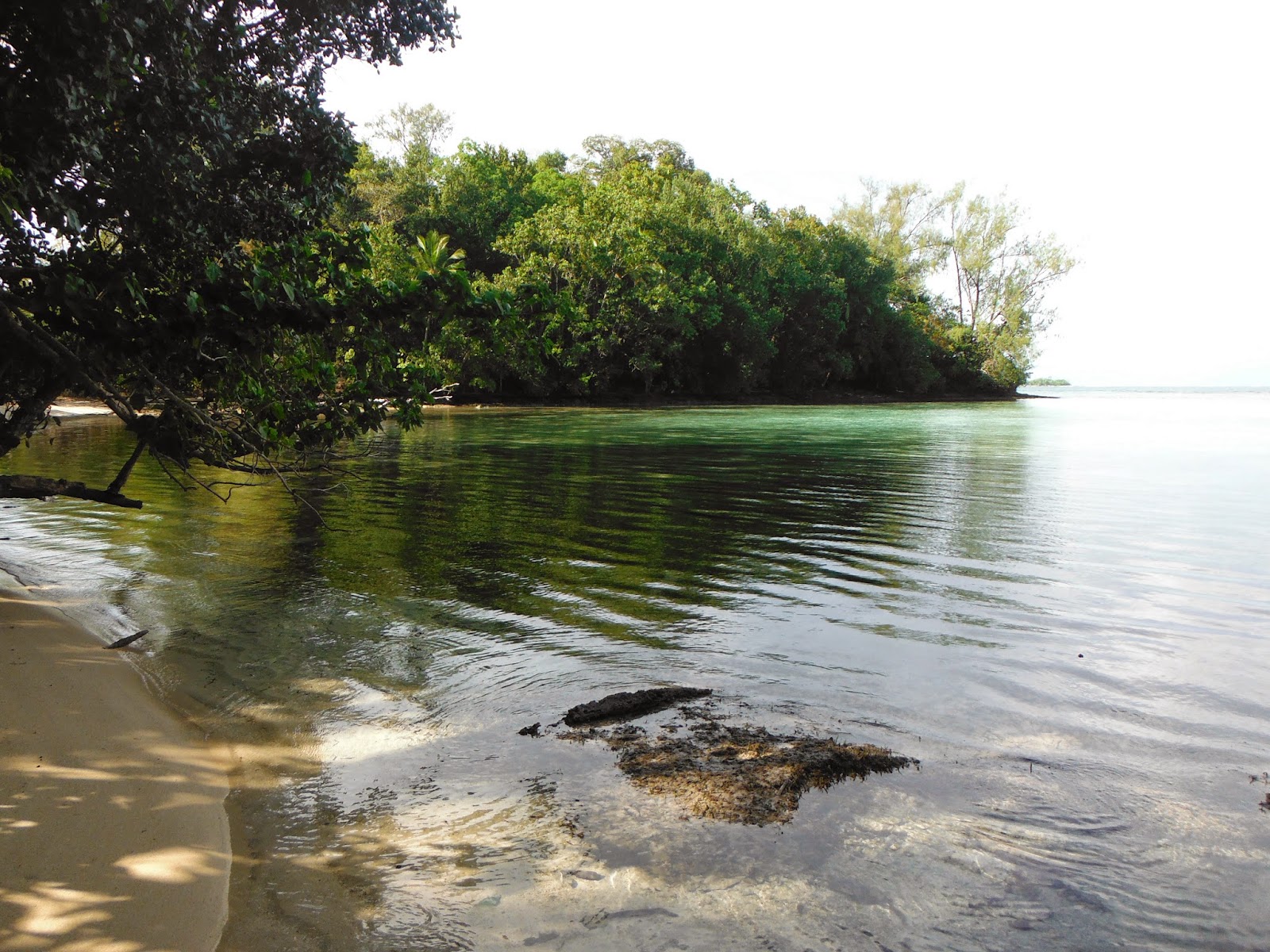 |
| Lagon at the back part of the island |
There was no internet, barely any electricity and limited choices of food based on what the local produce and fishermen caught. Being in such a remote place it was expected and we truly did not mind to eat lobster every day and to be disconnected from the rest of the world! It was absolutely blissful island life.
On our last evening we decided to splash and visit the nearby higher end hotel Sanbis for dinner. They had internet and I was in much need of connecting to reorganise my next trip to Vanuatu the day after.
 |
| Diving trip to nearby corals/islands |
Sanbys was a slightly more luxurious place than Fatboys where we were staying. It featured a few American tourists, a pool table, an outdoor veranda, and open air restaurant and a few nice rooms. The owners and the guests mingled as if everybody was part of the same family. It was cosy and homey.
While we were having dinner it started to pour down in a very dramatic way only tropical islands experience. Water was coming from all sides, the wind was pushing the rain in every direction and the drops were hitting the bamboo roofs hard. So we waited and waited enjoying our wine until it became quite late and we realised we had no choice but to brave the weather and make it back to our hotel for the short night.
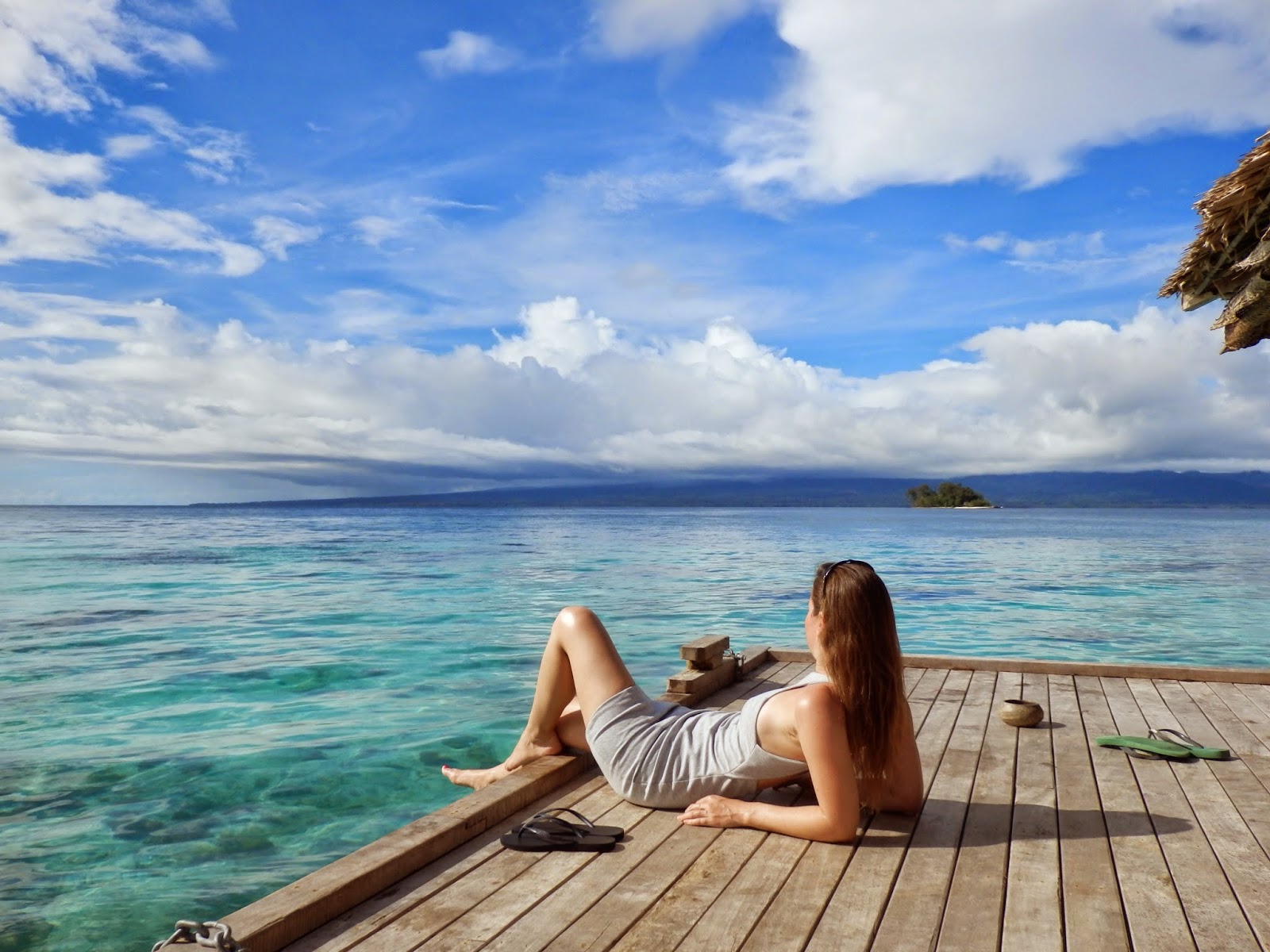 |
| The views from the hotel's jetty |
We donned raincoats the hotel lent us and jumped on the boat. Needless to say we got soaked, completely. But we didn't care because the trip was one of the most memorable moments I have ever experiences. As we left the hotel's pier we found ourselves in the most absolute darkness only with the stars as witnesses of the beautiful natural phenomenon in front of us: luminescent plankton all around us illuminating as we sailed through as if someone had turned on the Christmas tree lights.
Rain pouring down and the sea lit by thousands of small little creatures made me feel like I was in a dream from which I never wanted to wake up. Despite getting more and more soaked the longer the ride I did not want it to end. Ghizo got under my skin.
I fell asleep with that beautiful image which was temporarily disturbed by the practicalities if having to re-pack, all our clothes completely drenched in water.
 |
| Our beach hut |
But that was not the only magical memory Ghizo left on us. On our last morning, as we readied to leave and we settling the bill we experienced two more incredible moments. One positive and one sad.
The fishermen were bringing their daily catch to the hotel's pier to sell to the chef and we saw that, in their boat, aside from fresh fish they had also caught a sting ray and a turtle! The turtle was still alive as the fishermen can only catch it and put it in the boat upside down so it is completely incapable of moving. We we shocked as well as saddened by the situation. On one side the fishermen skills were admirable. Despite common perception of turtles being slow animals sea turtles are incredibly fast. If you have ever tried to chase one while diving or snorkeling you will know that it is virtually impossible. Yet that fisherman had managed to swim faster than it, hug it from behind and bring it into the boat. On the other, this was a stark reminder of life in the most remote and naturally rich parts of the world here subsistence and customer prevail over conservation.
 |
| The fishermen's boat |
To the fisherman the turtle was a very important source of income and his effort and training to catch it an admirable skill worth rewarding. To us this was an extremely saddening image that made us wonder how many more turtles would follow the same fate.
Thankfully our last image of Ghizo was a pod of dolphins who accompanied us to the airport as we were riding the waves from the hotel. It was a much more beautiful image to be left with as the friendly animals played in the water next to us.
Have you been to Solomon? And to Ghizo Archipelago?
Are you looking to go? Let me know if you would like any tips or recommendations
26 March 2014
Feeling at home among lagoons, isolated islands, limestone rock formations and crystalline waters in El Nido
Arriving at El Nido is like coming back home after a trip, you are welcomed by the warm voices, the happy rhythm of their songs and the smiles on Filipino faces. They know how to make someone feel like they belong. I have been here three times and every time I am happy I made the choice again.
I can't remember how we discovered the place but when we started to come to Manila for work we did a bit of research and realised that the large island of Palawan, easily recognisable on a map as the right arm of the Philippines, was the place to be.
The Philippines is an incredibly beautiful country made even better by the permanent smile and happiness of its people. After a few weeks coming here for work from Dubai on a 9h flight each way, I realized I was happier, it turns out their optimism and kindness is contagious. I wanted to come back again and again and I developed a strong nostalgia and melancholy when I stopped coming here. They always made me feel at home.
El Nido is an hour's flight from Manila and 238km from Puerto Princesa. On a snap decision, we bought tickets to Puerto Princesa on our first trip to Manila only to realise it's a day's driving to get to El Nido on unpaved roads. Not the best alternative since you can fly direct with ITI and stay at one of the wonderful El Nido Resorts.
 |
| Small lagoon |
Together with Sulu Archipelago, Sabah, and South China Sea, El Nido and Palawan are located in the tectonically active and seismically active Sunda Plate a plate that is entirely separate from the Philippine Mobile Belt to which the rest of the Philippines belongs. The rocks and limestone cliffs of El Nido are similar to those that can be found in Ha Long Bay in Vietnam, Guilin in China, as well as Krabi in Thailand, all of which are part of the Sunda Plate. When you paddle around or arrive by boat to the resort you will feel exactly as if you were in Phang Nga Bay in Thailand or in Halong Bay in Vietnam.
 |
| Lagen Resort |
Tourism in the area only started in 1983 shortly after it was discovered by a group of stranded divers. The first ever resort to open is the one I visited on my last trip, Miniloc. Since then, the area evolved from a turtle sanctuary to a managed resorce protected area in 1998. This status gives an area of 900 sq km the status of pristine eco-system. The government needs around USD200,000 a year to preserve and maintain the area which is financed by a small conservation fee tourists pay (USD0.5 per day). Under its umbrella there are seveal species of protected animals and plants including the elusive dugong (I never saw one in my three trips), dolphins, turtles and sharks more commonly spotted.
El Nido town is a sleepy very basic village where the Treasury office lies at a corner where children take a pee, dogs, cows and goats roa the streets and the roads and small "mum and pap" shops dot the area selling all sorts of individually packed items: instant coffee, detergent, cookies...you name it. There are a couple of dive shops, a couple of restaurants and bars and even an "exercise corner" aka a gym where you can use some machines. The population lives of agriculture and fishing and in recent years, tourism.
When I first came here in 2010 the are was much less developed and the guest were mostly local Filipinos or expats living in Manila. Today, there seemed to be a dramatic increase in the number of visitors from Far East countries.
The details
How to get there
El Nido Resorts will organize all your travel from Manila. They own the airstrip where private planes managed by ITI land. The flights usually run in the mornings as the properler planes are better for daytime landing. Departures from Manila are at 9am, 11am and 3pm. Returns run until 5pm. Check in is from a separate hangar between Terminal 1 and 3 in Manila and it is hard to find as the sign is only small. Look out for it on Andrew Road on the right hand side when you are going towards Manila and on the left when you drive from Terminal 3. When you land in El Nido you will meet everyone ina small lounge area where there will be refreshments and people are distributed into groups depending on the resort they are booked into. After a 15min jeepney ride to the pier the journey ends with a boat transfer to your resort lasting between 30-45min
Best time to visit
Where to stay
 |
| Lagen Resort pool |
The latest addition is Apulit resort which is slightly farther and requires a longer van drive.
Ranked by price Miniloc is the most affordable followed by Lagen, Apulit and Pangulasian. Although prices for the first three are very similar starting at around USD350 (PhP15,000) per night for a double room with full board.
 |
| Miniloc overwater bungalows |
Acommodation includes all meals with fresh local produce and all activities.
If you feel like getting up from your sunbed there is plenty to keep you occupiued. You can paddle around the resorts' islands on a kayak or try your skills at paddleboard. The area around Lagen and Miniloc also has a beach club on an isolated island where you can try to windsuf. The resorts offer tours to nearby islands such as snake island or to see the Big and Small Lagoons on a boat. You can then jump off and snorkel or paddle around. The Small Lagoon is only accessible through a tiny opening on the rocks so you can only get in swimming or kayaking and it is well worth it. All of these activities are included in your full-board rate. In Miniloc they also feed the jackfish every morning and it is a show to not be missed. These animals can reach 1m or more and are very aware that the resort will feed them large chunks of fish at breakfast sso they eagerly await at the end of the pier. If you are brave enough you can also don snorkel and mask and jump in with them. They are extremely fast at grabbing the food and will jump out of the water to catch it which can be pretty scary. The resorts aso have ping-pong tables, a basketball court and a beach volleyball net.
The only chargeable items are spa treatments and diving.
The resorts can also organize private dinners in secluded spots or picnics in romantic islands. In the Big Lagoon we saw a raised platform that looked very much like a wedding spot.
What to do
 |
| Feeding the Jackfish |
 |
| Kayaking into th lagoon |
The only chargeable items are spa treatments and diving.
The resorts can also organize private dinners in secluded spots or picnics in romantic islands. In the Big Lagoon we saw a raised platform that looked very much like a wedding spot.
Practicalities
- Bring a dry bag because you will spend a relevant amount of time in the water and if you don't have one you won't be able to take your essentials with you kayaking, particularly your camera
- If you have waterproof boots they will be useful to walk on the beach which has quite a lot of rocks and corals
- The overwater villas on Lagen and Miniloc are good but make sure to request one that is at the end of the pier or you may not enjoy the tranquility of the place being so close to the beach and the rest of the action. And if you plan a romantic escape, make sure to be away from families with children. El Nido Resort are very popular with families.
With the exception of Pangulasian don't cone expecting luxury. The resorts are all made with local materials, bamboo, local trees, etc. and are very nice and well appointed but are unpretentious and barefoot. There are no TVs but today, the internet works very well everywhere in the resort and the rooms all have AC units. This is a place to feel at home, soak in the Filipino hospitality and their happiness and, like me, go back home with a renewed faith in humanity.
Subscribe to:
Posts (Atom)